Explainable Reaction Atlas
Jason Li (University of Utah), Rodrigo de la Nuez Moraleda (Nanyang Technological University), Dhruv Meduri (University of Utah), Kelin XIA (Nanyang Technological University), Bei Wang (University of Utah)

Jump to Discussion
Links
Sign in to access the Paper PDF.
Abstract
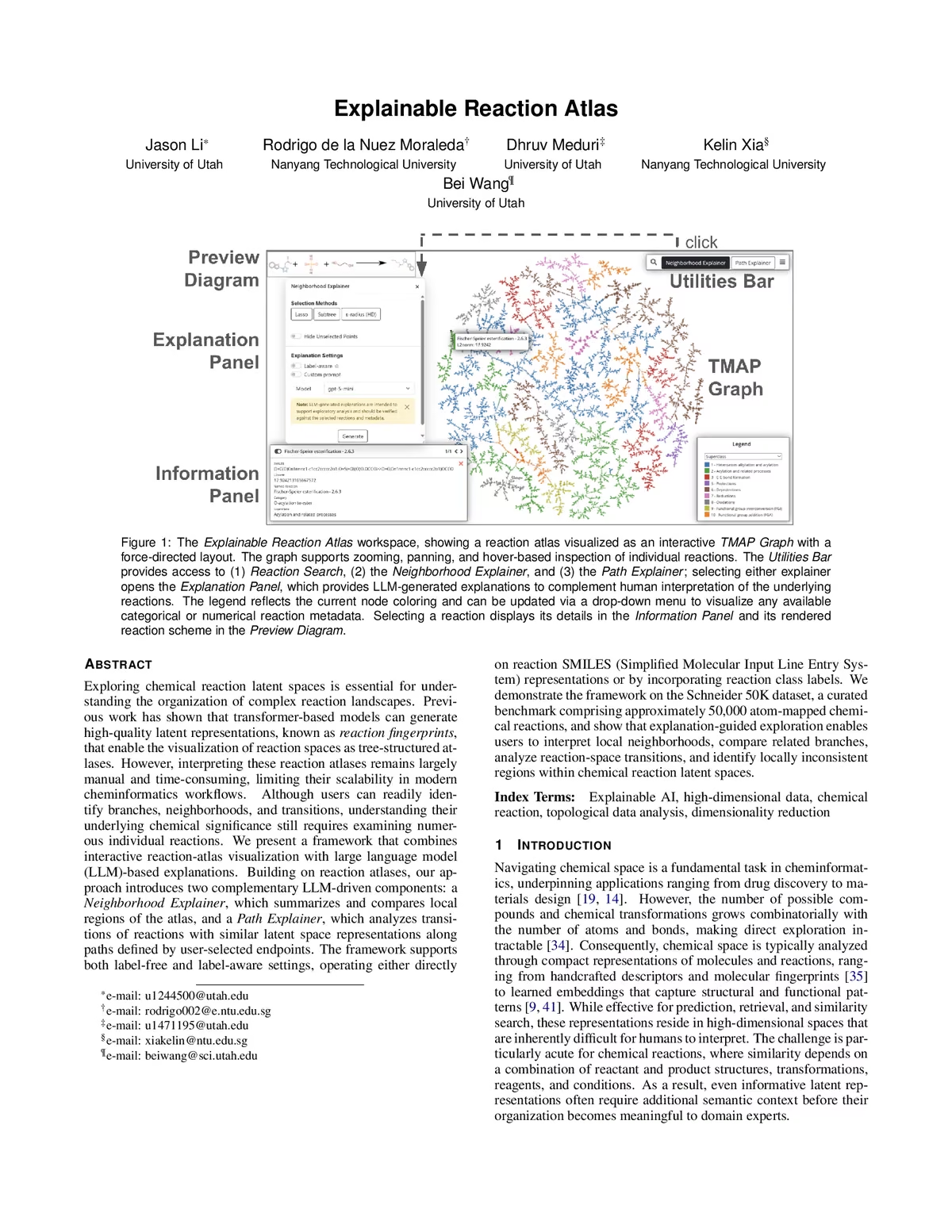
Exploring chemical reaction latent spaces is essential for understanding the organization of complex reaction landscapes. Previous work has shown that transformer-based models can generate high-quality latent representations, known as reaction fingerprints, that enable the visualization of reaction spaces as tree-structured atlases. However, interpreting these reaction atlases remains largely manual and time-consuming, limiting their scalability in modern cheminformatics workflows. Although users can readily identify branches, neighborhoods, and transitions, understanding their underlying chemical significance still requires examining numerous individual reactions. We present a framework that combines interactive reaction-atlas visualization with large language model (LLM)-based explanations. Building on reaction atlases, our approach introduces two complementary LLM-driven components: a Neighborhood Explainer, which summarizes and compares local regions of the atlas, and a Path Explainer, which analyzes transitions of reactions with similar latent space representations along paths defined by user-selected endpoints. The framework supports both label-free and label-aware settings, operating either directly on reaction SMILES (Simplified Molecular Input Line Entry System) representations or by incorporating reaction class labels. We demonstrate the framework on the Schneider 50K dataset, a curated benchmark comprising approximately 50,000 atom-mapped chemical reactions, and show that explanation-guided exploration enables users to interpret local neighborhoods, compare related branches, analyze reaction-space transitions, and identify locally inconsistent regions within chemical reaction latent spaces.